
Condo Demolition in Miami: Complex Multi-Unit Considerations
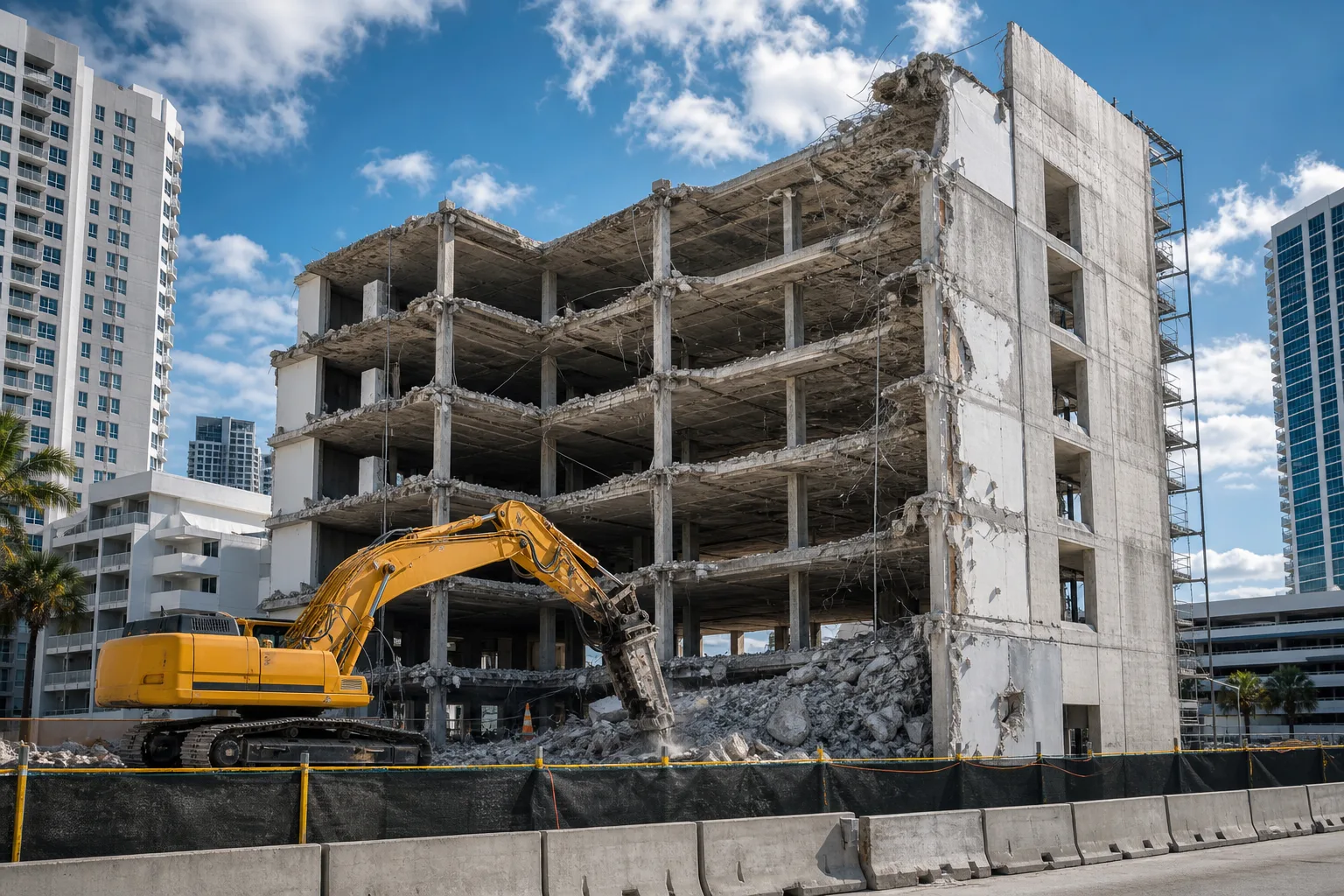
Miami’s condo demolition landscape is very different from single-family home demolition. Since the Surfside tragedy, property owners, associations, and developers have faced more pressure to manage shared ownership, legal rules, and the displacement of hundreds of residents at once.
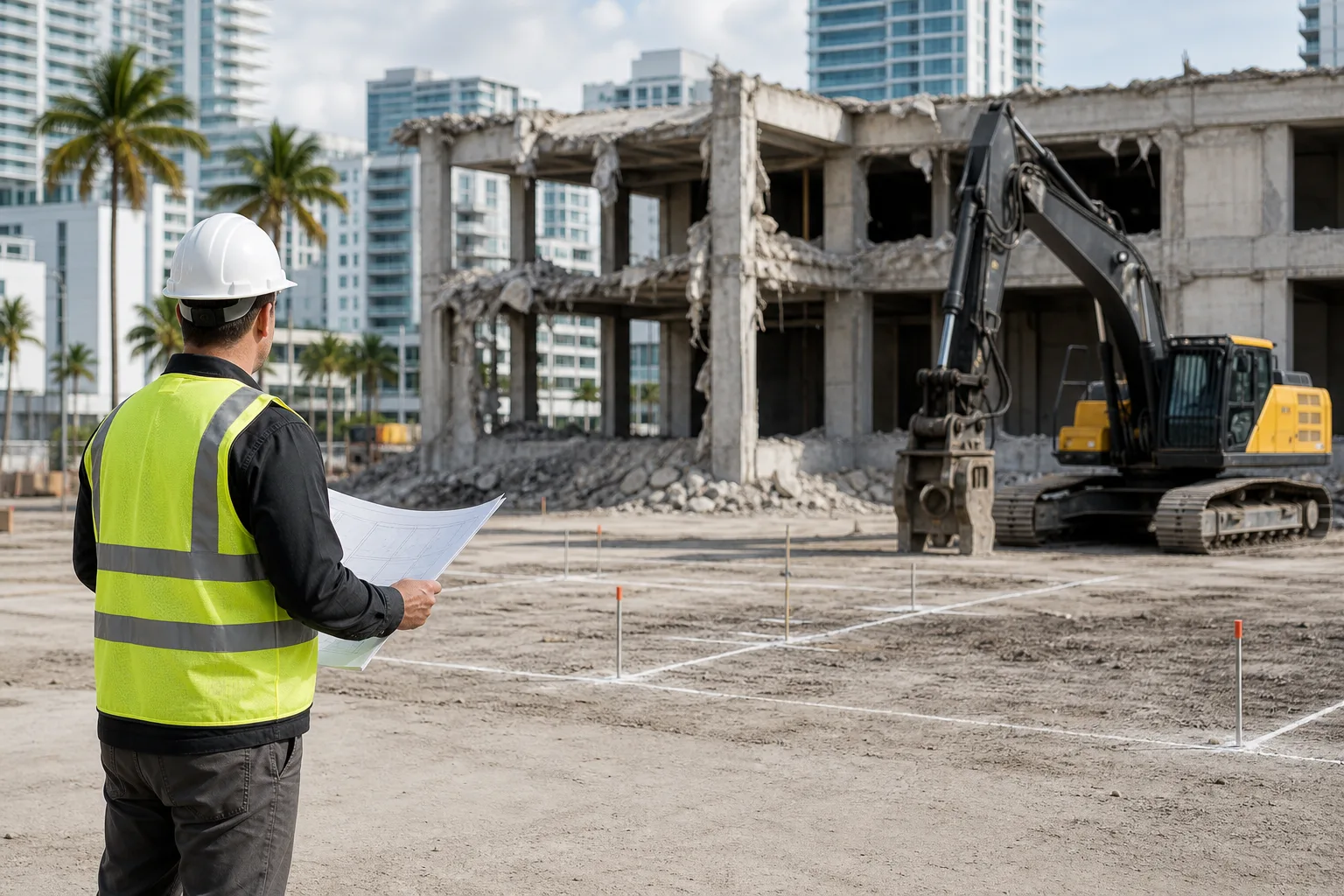
Understanding Multi-Unit Condo Demolition in Miami
Condo demolitions in Miami involve unique services:
- Multi-Owner Coordination: Decisions often involve 50–500+ owners, each with different financial abilities and preferences.
- Shared Infrastructure: Contractors must safely remove shared plumbing, HVAC, electrical, and elevator systems.
- Phased Evacuation: Entire populations of 100+ households must be relocated at the same time.
- Environmental Testing: Hazards like asbestos or lead must be assessed across common areas and units.
- Association Oversight: Decisions are governed by condo boards, not individual owners.
Only contractors with multi-unit experience can handle these large-scale challenges.
Legal Framework and Voting Complexities
Florida condo law makes demolition more complicated than tearing down a single-family home.
- Voting Rules: Condo demolitions usually need 75%–100% owner approval [1].
- Conflicting Interests: Some owners welcome redevelopment, while others face financial hardship.
- Legal Disputes: Minority owners can delay or block demolition, as seen in the Biscayne 21 case.
- Emergency Orders: Miami-Dade can now fast-track demolitions of unsafe buildings without waiting for owner votes.
Technical Challenges of Multi-Unit Demolition
High-rise condos demand careful planning:
- Shared Systems: Utilities are interconnected and must be disconnected safely.
- Structural Concerns: Tall, dense buildings near other structures need advanced demolition techniques.
- Hazmat Removal: Contamination can affect multiple households, requiring full-building remediation.
- Site Access: Limited space in urban settings makes equipment staging and debris removal harder.
These factors extend timelines and costs compared to single-home demolitions.
Displacement and Community Impact
The demolition of a condo displaces entire communities:
- Mass Relocation: A single project can uproot 50–500+ families at once.
- Affordable Housing Loss: Older condos often serve as affordable housing. Their removal eliminates multiple units simultaneously.
- Breaking Social Ties: Long-established community networks are disrupted.
- Relocation Issues: Miami’s rental market struggles to absorb hundreds of households at once.
Careful relocation planning is essential to reduce disruption.
Financial Complexities
Money matters in multi-unit demolitions are rarely simple:
- Shared Costs: Expenses are divided by ownership percentage, often sparking disputes.
- Owner Capacity: Some owners can afford assessments, while others cannot.
- Insurance and Liability: Shared insurance and collective liability must be sorted out.
- Bulk Purchases: Developers typically negotiate to buy entire buildings, requiring multi-party deals.
Return on Investment (ROI)
Condo demolition often creates higher property value than single-home teardowns:
- Beachfront Sites: Values can rise 45%–65% with luxury redevelopment.
- Urban Properties: Redevelopment boosts values 30%–50%, especially for mixed-use sites.
- Older Affordable Condos: Values can rise 60%–90% when converted to high-end projects.
- Historic Buildings: Gains are lower, around 20%–35%, due to restrictions.
These numbers show why developers are eager to redevelop older condo sites.
FAQs
1. How do multi-unit condo voting requirements work for demolition?
Condo demolitions require supermajority approval, usually 75%–100% of owners, unlike single homes where one person decides. This can create deadlocks and legal fights.
2. What happens to residents during multi-unit condo demolition?
All residents must leave, sometimes hundreds of households at once. Finding temporary housing is difficult, and associations may provide relocation support.
3. How are demolition costs shared among multiple condo owners?
Costs are divided based on each unit’s ownership share in the condo documents. Disputes can arise if some owners cannot afford their portion.
4. Can minority owners block multi-unit condo demolition?
Yes, if voting thresholds are not met. In some cases, a small group of owners can delay or even prevent demolition.
5. How long do multi-unit condo demolitions take?
They usually take 6–18 months because of complex planning, unlike single-family demolitions that finish in 1–3 months. Unsafe buildings may be demolished faster under emergency orders.
6. What makes multi-unit demolition more complex than single-family?
Multi-unit projects require coordination between dozens or hundreds of owners, managing mass relocation, and handling shared systems like plumbing and electrical.
Final Takeaway
Condo demolition in Miami is far more complex than single-home teardowns. It requires expertise in law, engineering, financial negotiations, and community management.
With careful planning and professional guidance, these projects can unlock major value while responsibly addressing the needs of residents and stakeholders.
Reference:
- https://www.leg.state.fl.us/statutes/index.cfm?App_mode=Display_Statute&URL=0700-0799/0718/Sections/0718.117.html#:~:text=Any%20unit%20owner%20who%20fails,date%20of%20the%20termination%2C%20unless